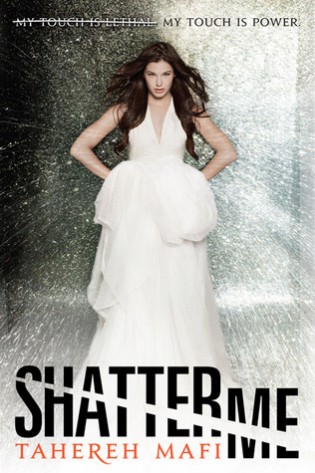
 Shatter Me by Tahereh Mafi
 Series: Shatter Me #1
Published by HarperTeen on November 15th 2011
Pages: 338
Genres: Dystopian, Sci-Fi, Young Adult
Format: Hardcover
Source: Library
Amazon・ Good Books・Book Depository
Goodreads

Juliette hasn’t touched anyone in exactly 264 days.
The last time she did, it was an accident, but The Reestablishment locked her up for murder. No one knows why Juliette’s touch is fatal. As long as she doesn’t hurt anyone else, no one really cares. The world is too busy crumbling to pieces to pay attention to a 17-year-old girl. Diseases are destroying the population, food is hard to find, birds don’t fly anymore, and the clouds are the wrong color.
The Reestablishment said their way was the only way to fix things, so they threw Juliette in a cell. Now so many people are dead that the survivors are whispering war– and The Reestablishment has changed its mind. Maybe Juliette is more than a tortured soul stuffed into a poisonous body. Maybe she’s exactly what they need right now.
Juliette has to make a choice: Be a weapon. Or be a warrior.
Prose is a very subjective thing. What one reader finds to be beautifully written, another finds trite and overdone. Is it excess, or great writing? It all depends on your personal reading tastes and preferences.
I bring this up because Tahereh Mafi’s Shatter Me is a debut novel that is pushing those who read it to extreme opinions. You apparently either think that it’s a great start for a promising new author, or you think that it’s a poorly written lump of ridiculous metaphors and horrid imagery. It’s been interesting to see such conflicting reactions, and that’s the primary thing that drove me to pick this one up.
The other reason is that I’ve been wanting something similar in style to Daughter of Smoke and Bone. Taylor won me over with her gorgeous prose, and I demand more!
Anyway, Shatter Me is a difficult book to review, because I can’t definitively choose a side. I didn’t hate it. I didn’t love it. There were plenty of things that I disliked. There were just as many things that I enjoyed. As such, I’ve taken neutral ground on this one.
THE BAD
As is to be expected of a new author’s first novel, this book has its fair share of problems. And many of them are too prominent to be ignored.
1. The Writing (or “MY EYES! TOO MUCH PURPLE!”)
Mafi loves to get fancy with her words, and this isn’t always a good thing. Most of the book drowns in completely unnecessary, over-the-top description that oftentimes makes little sense. Look, I’m all for some pretty imagery, but try not to go completely overboard with it. Reading things like this:
“He shifts and my eyes shatter into thousands of pieces that ricochet around the room, capturing a million snapshots, a million moments in time. Flickering images faded with age, frozen thoughts hovering precariously in dead space, a whirlwind of memories that slice through my soul.”
Or this:
“His lips are spelling secrets and my ears are spilling ink, staining my skin with his stories.”
Or even this:
“I always wonder about raindrops. I wonder about how they’re always falling down, tripping over their own feet, breaking their legs and forgetting their parachutes as they tumble right out of the sky toward an uncertain end. It’s like someone is emptying their pockets over the earth and doesn’t seem to care where the contents fall, doesn’t seem to care that the raindrops burst when they hit the ground, that they shatter when they fall to the floor, that people curse the days the drops dare to tap on their doors.”
…is annoying. Passages like these made the novel far too melodramatic and silly. What’s frustrating is that it’s all so unneeded. Take the above quote, for instance. Instead of that entire paragraph, Mafi could have used something like this:
“It was raining.”
That wasn’t too hard, was it? Simple and to the point.
The other big problem with the writing is that much of it makes absolutely no sense. I mean, look at this:
“His gaze is fixed on me: calm, unflappable; 2 buckets of river water at midnight. I’d like to cry into his eyes.”
What does that even mean!? Let’s look at another:
“Hate looks just like everybody else until it smiles. Until it spins around and lies with lips and teeth carved into the semblance of something too passive to punch.”
I’ve read that line a good half-dozen times, and I still don’t understand it. And then you have incredibly silly descriptions like:
“He’s wrong he’s so wrong he’s more wrong than an upside-down rainbow.”
Hm. Okay.
Seriously, Mafi. Cool it with the prose. This book is practically bleeding purple. And that’s just messy.
And, in regards to the “cross-out” and “using numerals instead of words” gimmicks: Both are fairly creative, and work for the most part. The strike-outs were initially irritating, but became more tolerable as the story progressed. The use of numerals, on the other hand, just gave Mafi the excuse to throw out random measurements like “5,000 degrees” to describe Juliette’s feelings. To be fair, though, most of these exaggerations aren’t too ridiculous. I just wish the author was more consistent in using them. The strike-outs are initially used quite often, but disappear entirely by the end of the book, while the numbers are sometimes spelled out instead of put into digits, with no clear rule distinguishing the difference. If you’re going to write in a “unique” way, you should probably do so for the entirety of the novel.
2. The Protagonist (Or “I’m So Perfect! Don’t Love Me!”)
Aside from the fact that Juliette can kill people by touching them, she’s pretty much the zenith of perfection. It’s the typical YA trend, only in reverse: our heroine has to stay away from others because she’s a complete monster, yet doesn’t realize how beautiful and smart and kind and amazing and generous and wonderful she truly is.
Even the whole “killer touch” thing isn’t much of a character flaw, as nearly every male character in the book spends most his time assuring Juliette that she has a gift, that she is unique, and that she is pretty much the greatest person to ever grace the face of the Earth.
Juliette’s only real “downside” is the fact that she’s so insecure about herself. She doesn’t think she’s pretty. She doesn’t think she’s gifted. She doesn’t think she deserves love or friendship or human connections. What important moral lesson has she learned by the end of the book? How does she change for the better?
…
She accepts herself for who she is.
So, essentially, her character goes from refusing to believe she is perfect to believing she is perfect. Nice.
3. The Love Triangle (Or “This Relationship Is Wrong! Let’s Make Out!”)
We all knew that it would happen. Obviously, a series cannot be considered “YA” if it doesn’t have a…can you guess it? Say it with me, now!
LOVE TRIAAAANGLE!
Good job!
Honestly. Why can’t the protagonist just fall in love, and then stay in love? Do we really need to throw in another hunky guy who has inexplicable chemistry with our heroine when the original hunky guy is such a “great” match for her already?
What’s that? How can she have a real relationship with either when she can’t touch anyone? Excellent question! This is where the magic of a CONVENIENT PLOT TWIST comes into play.
You see, it turns out that Juliette, despite the fact that every other person she has ever touched has died (or nearly died), can rub skin with our two sexy male leads without consequence! She’s so lucky that the only two people in the world that she can have contact with are both near her own age, incredibly handsome, and completely obsessed with her!
How convenient!
What’s especially annoying is the fact that the second love interest is a complete ass who has done nothing but abuse, use and torture Juliette for the entirety of the story. The first, alternatively, is kind, thoughtful, sweet, gentle, and caring. He’s perfect (*groan*) in every way. And yet, for some inexplicable reason, Juliette feels conflicted in her feelings.
Ugh. Of course, he must be completely redeemable because he has a depressing family life, a tragic childhood and is utterly gorgeous. Clearly, he’s just misunderstood!
And to elaborate on that “utterly gorgeous” part: I do so love reading about how strong so-and-so’s jawline is, how sculpted so-and-so’s muscles are, and how beautifully so-and-so’s eyes shine every three pages. I didn’t realize how many people have crooked smiles, either. If that’s not sexy, I don’t know what is!
Now, this lovely setup/tryst has yet to actually take off, but I think that it’s blatantly obvious what the sequel has in store. The seeds have been sown, and it’s too late to take it back now!
4. The Ending (Or “I Didn’t Know This Was An X-Men Sequel!”)
Up until the last 50 pages or so, the story plays out like your typical YA dystopian series, with a dash of the supernatural thrown in for good measure. Let’s make sure that everything was included:
-Introverted heroine who thinks she’s plain/ordinary/evil, but is actually a supermodel/goddess with a heart of pure gold? CHECK!
-Two love interests who are both gorgeous and have incredible muscles? Don’t forget: at least one of them must be a jerk! CHECK!
-Mysterious company/organization that tortures/kills/abuses innocents to retain power over the entire planet, making them evil incarnate? CHECK!
-Fancy sci-fi, futuristic junk? CHECK!
So far, so good! I feel it necessary to point out that the occasional use of advanced technology is rather jarring, because I spent much of the novel thinking that the story took place in contemporary times. Or, if anything, the near future. So the sudden inclusion of SUPER AMAZING GADGETRY halfway through the plot was difficult to accept.
Anyway, I was willing to buy the idea that Juliette has powers. It gave the novel a touch of creativity, and I was eager to discover why she had these abilities. So when we discover that there are others like her, and that these people have come together to learn how to control their gifts and SAVE THE FREAKIN’ WORLD, everything took an abrupt turn into comic-book superhero territory. Which is just silly. What a way to wrap everything up.
THE GOOD
Wow. I really tore into this one, didn’t I? Now, don’t get me wrong: I like this book, but it’s so flawed that much of my enjoyment was tainted as I worked my way through it. Anyway, let’s look at some of the things that this book does right.
1. The Writing (Or “There’s Potential Here”)
Yup. The writing is both a flaw and a strength. Despite the problems, I think Mafi has talent. She just needs to tone it down a bit and hire a stricter editor. While the first few chapters are practically vomit-inducing in their excessive prose, the writing improves dramatically as the story progresses. Mafi has some very good passages sprinkled throughout, with writing that is tight, clever and genuinely funny. Juliette is actually an enjoyable narrator at some points because of it. It’s a shame that these stretches are marred by the unnecessary inclusion of overly flowery description.
In the interest of remaining (somewhat) fair, let’s look at some passages that are actually well done (in my opinion, anyway):
“I’ve run out of words. My pockets are full of letters I can’t string together and I’m so desperate to say something that I say nothing and my heart is about to burst through my chest.”
A bit too melodramatic, I admit, but I like it. It’s probably just because it has to do with words, and it makes my inner bibliophile happy.
“For the first time in my life, I walk forward because I want to, because I feel hope and love and the exhilaration of beauty, because I want to know what it’s like to live. I could jump up to catch a breeze and live in its windblown ways forever. I feel like I’ve been fitted for wings.”
Quite good, don’t you think?
“‘How old are you?’
‘I’ll be eleven next year.’
I grin. ‘So you’re ten years old?’
He crosses his arms. Frowns. ‘I’ll be twelve in two years.’
I think I already love this kid.”
See? There’s promise here! I know it!
2. Adam (Or “He’s Actually Likable?”)
Adam wins an award for being one of the the YA male love interests that I took a liking to the quickest. He was a bit of an ass in the beginning (aren’t they always?), but it was only for the first few pages and he had a sensible explanation for his attitude. He’s a good guy, and even though he falls into the category of being too perfect, he isn’t someone that I felt needed a major attitude adjustment. Or swift fist to the face.
And this is the perfect way to introduce my next point…
3. The Romance (Or “THEY’RE Actually Likable!?”)
Juliette and Adam’s relationship, though too dramatic and too perfect, is reasonably believable and sorta sweet. The fact that it isn’t insta-love is nice – the two had known one another since they were children, and had realistic reasons for being attracted to one another. Their feelings developed slowly (sort of) but steadily.
While this particular pairing is one that I buy, the other blossoming relationship is one that I do not not. Really, Juliette? You have growing feelings for Warner? Stupid, stupid girl. It isn’t much of an issue in this book, as the focus is on Adam, but we all know how the sequel will play out. Adam will grow distant, physically or emotionally, from Juliette, she will be devastated and unable to live, Warner will swoop in and inexplicably become a nice guy, they’ll fall in love, and then the drama can REALLY begin. Hooray.
And if that doesn’t happen, I get the feeling that Kenji will make a nice substitute. No shortage of ideal male specimen in this world!
4. The Plot (Or “Seriously, It’s Not That Bad!”)
I’ll be curious to see how Mafi expands on her worldbuilding in future installments. I like the idea: a mysterious corporation swoops in as the world falls apart from human greed and abuse, promising a solution, then shows its true colors and ends up making things worse. It needs to be expanded on if it’s going to really work well, but I’ll take what I can get for now. The reveal that things are not as bad as they actually seem, and that The Reestablishment has been lying for its own gain was a nice twist, and leaves plenty of potential for interesting story development in the sequels.
Of course, the ending kind of kills things, as it makes it seem like the rest of the series is going to be a superhero/supervillain showdown of comically silly proportions, but I’ll hold on to the hope that Mafi can make it work.
IN CONCLUSION…
So, yeah, I kind of liked Shatter Me. It has plenty of teeth-grinding stupidity, but I certainly don’t dislike it as much as many others seem to. I think that Ms. Mafi shows a great deal of promise, and I’ll be reading the rest of the trilogy to see if she can overcome her issues and smooth out those rough edges.
FAVORITE QUOTE
“I spent my life folded between the pages of books. In the absence of human relationships I formed bonds with paper characters. I lived love and loss through stories threaded in history; I experienced adolescence by association. My world is one interwoven web of words, stringing limb to limb, bone to sinew, thoughts and images all together. I am a being comprised of letters, a character created by sentences, a figment of imagination formed through fiction.”
This makes my book-loving self happy. Even if it is a bit too over-the-top.

Paul Beimers
Latest posts by Paul Beimers (see all)
- Review: Slasher Girls & Monster Boys by Misc. - August 18, 2015
- Review: The Lies of Locke Lamora by Scott Lynch - April 16, 2015
- Review: The Sculptor by Scott McCloud - January 24, 2015
- Review: Gone Girl by Gillian Flynn - October 2, 2014



godisnarcissus
Great review. I just requested this one from the library, and now I’m a little worried. Though, I was kind of looking for something on the light side, as the last book I read kind of ate my soul, so this might be fine. In any case, should be interesting.
heykelley
Nice review. I wasn’t as bothered by the purple prose and strikeouts as you were, but I do agree it got a bit over-the-top at times. You make a really good point about the only flaw Juliette really has is insecurity. …
It kind of surprises me that you liked the romance between Juliette and Adam. I found it annoying. So they saw each other from across the playground as kids and never even talked to each other, but were secretly in love with one another ever since? I mean, I *guess*. Also, Adam didn’t really seem to have any flaws, ohh he’s so perfect, blahhh (so tired of perfect, *beautiful* love interests). And don’t even get me started on Warner. Whatever.
I mean, yeah, I liked the book. But still. You’re making me kind of dread Unravel Me now. Sorry, I know I’m rambling. I hope this comment makes some sense.
PBeimers
heykelley Thank you! Purple prose doesn’t usually bother me much, but the use of it here was just overwhelming. And, to be honest, I still don’t fully understand what it is about Adam and Juliette’s relationship that makes it acceptable to me. I certainly don’t love it, but it also doesn’t frustrate me like many YA pairings do. I think that it might be because I see it as being on neutral ground – it’s not anything special, but it doesn’t do much harm either.
As for “Unravel Me,” I have no idea what to expect. I’ll do my best to read it with an open mind, however!
livin_thru_arts
The writing depends on how you view it. I loved it because I took meaning to it, fitting it with Juliette’s character since she had been isolated for so many many many days and the only thing she really had that was close to her life was her journal she wrote in. The prose expresses Juliette’s voice, an outlet for J’s creativity to spill. She developed her own way of expressing herself, of describing things, while locked away, and Mafi’s prose shows this.
Now that’s how I see the writing. The style IS Juliette. (And the number thing… Juliette loves numbers, the visible numerals, so hence why they were used as numerals in the text.) Others, however, just see it as something that Tahereh Mafi tries to be different with. But each to their own I suppose.
Nice review though. Unravel Me is slightly better, even if a bit contrived.
Kiarra
I thought the book was absolutely amazing and that may be because my personality is a bit similar to Juliette’s. I honestly loved the book(s) but I guess some of those weird details kinda confuse you but I didn’t really worry about those a lot and I enjoyed the book so much that I didn’t really bother on looking back at them lol.
veela_valoom
Twitter: veela_valoom
This is a very balanced review of a book that most people are completely divided on.
Lilysbookblog
I really loved Shatter Me! i enjoyed Amfi’s unique writing style and found it almost to be sort of lyrical at times. i also liked how it reflected how juliette must of felt and how it reflected her being locked away for so long! Now the love traingle— Honestly I’m not one for love traingles, I am incredibly picky but I felt it really did benefit the plot and lay out the ground for future companion novels. I recommend reading DESTORY ME the novella told from Warners POV because everything becomes very clear and we understand his intentions better and actually view him in a different light. many people actually switch sides after reading DM. Me well I didn’t exactly have a side in Shatter Me, I was intriguied by Warner in SM but I wasn’t head over heals for Adam either but then DM just made me LOVE Warner.
cynicalsapphire
Wow, I’d heard that I wouldn’t like the writing in this book, but I hadn’t actually seen any. This is WAY worse than I was imagining. Her prose is fucking royalty, based on all the purple it’s sporting. Ick. I just can’t even. She thinks she’s Homer, but, honestly, I wasn’t a big fan of it when he did that either. I’m not a big fan of strikeouts either, unless it’s a journal. Is it a journal?
So, off topic, but there’s a manga series that I really like because the couple gets together in the first volume or two, and they stay a committed couple through the whole thing. It’s not the best treatment possible, but, hey, I’ve pretty much never seen that in ANYTHING, so it’s just refreshing. Love triangles can be done really well, but usually they are not. Based on that disgustingly cheesy, purple writing, I’m thinking this isn’t one of them.
“You see, it turns out that Juliette, despite the fact that every other person she has ever touched has died (or nearly died), can rub skin with our two sexy male leads without consequence!” <– *barfs*
Hmmm, okay, some of those quotes are alright.
Renae M
Shatter Me was one of the first YA titles I read and I remember being really impressed with it at the time. But after reading so many conflicting opinions and with some distance from the text, I sometimes have trouble remembering what exactly I liked about it. Your points about Mafi’s prose are right on—I think I liked them initially because they were pretty, but just now, reading over your review, I’m of the opinion that they might be a little excessive. Hmm. When (and if) I ever decide to pick up Mafi’s sophomore novel, I’d probably have to re-read this one to adjust my opinions.
AnnieIsOkay
Twitter: PamisOkay
When I read the first time: “Wow that’s sad.” “He knows her! Cute =3” “Warner is an asshole” “Go Kenji!” “Are they ever going to do IT?” “X men o_o”
Second time(Yeah, I forced myself to read it again because I got the 2nd book and didn’t remember much about the 1st): “Cottonballs in your throat? HOW IS THAT EVEN POSSIBLE?!” “My eyes are starting to hurt with so much scratching” *skipping pages* “Why do you like Warner?!” “You are depressing me now, Julie” “Get it together, please!” “X men flashback.”
shaungrl
I’m new to most YA work, being that I’m +55. I’ve entered this genre simply to find dystopian and/or the Fae realm that filled the “Escape Plan” for the moment. I understand what is meant by “purple prose” and would heartedly agree should I be reading it. Maggie Stiefvater started me on the audio road with her “wolves” series, btw. And I’ve found that listening to the book presents it in a way that allows the word pictures to thrive in optimum growing space…the theatre of the mind.
Shatter Me | cooking with the book club
[…] Cuddlebuggery Book Blog http://cuddlebuggery.com/blog/2013/01/31/book-review-shatter-me-by-tahereh-mafi-2/ […]
Meghan
Tahereh explained in a video that the numbers and strike throughs were there to show the state of Juliette’s mind, how she was on the edge of sanity, and trying to hang on to reality. As the book continues, Juliette is becoming more stable and is recovering from her 264 days in the asylum. So the strike throughs are not consistent only to show the character development.
The Unpopular Opinion Book Tag | Cuddlebuggery Book Blog
[…] readers. I don’t get it. Hush, Hush basically perpetuated rap culture, Shatter Me (Kat | Paul) contained a ship I cannot get behind (also the writing, ugh), and Darkfever has a […]
Theresa
This article helps me to gather details about Shatter Me by Tahereh Mafi series. Thank you for sharing Shatter Me by Tahereh Mafi review.
Theresa recently posted…Best Hand Crank Meat Grinder: Gideon Hand Crank Manual Meat Grinder Review
Best Smokers Info
Twitter: bestsmokersinfo.com
Agree with: “Great review. I just requested this one from the library, and now I’m a little worried. Though, I was kind of looking for something on the light side, as the last book I read kind of ate my soul, so this might be fine. In any case, should be interesting.”
123123123
Tahereh Mafi’s debut novel is spectacular. It is by far the most unique writing style in a dystopian book that I’ve read so far. I loved the writing style and quirkiness of this book. Juliette’s stream of consciousness narration is so much like how I experience life, how I write and think and sometimes talk. I could really relate to her, her little bit of craziness got inside my head, and I loved it. I would highly recommend Shatter Me to fans of dystopian fiction, The Hunger Games, Divergent, or those looking for a unique romance.
Jamie
Tahereh Mafi’s debut novel is spectacular. It is by far the most unique writing style in a dystopian book that I’ve read so far. I loved the writing style and quirkiness of this book. Juliette’s stream of consciousness narration is so much like how I experience life, how I write and think and sometimes talk. I could really relate to her, her little bit of craziness got inside my head, and I loved it. I would highly recommend Shatter Me to fans of dystopian fiction, The Hunger Games, Divergent, or those looking for a unique romance.
Maria
Great innovation