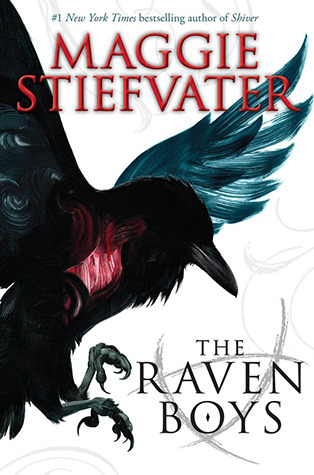
 The Raven Boys by Maggie Stiefvater
 Series: The Raven Cycle #1
Published by Scholastic Press on 18th September 2012
Pages: 409
Genres: Fantasy, Paranormal Fantasy, Paranormal Romance, Young Adult
Format: Hardcover
Source: Library
Amazon・ Good Books・Book Depository
Goodreads

“There are only two reasons a non-seer would see a spirit on St. Mark’s Eve,” Neeve said. “Either you’re his true love . . . or you killed him.”
It is freezing in the churchyard, even before the dead arrive.
Every year, Blue Sargent stands next to her clairvoyant mother as the soon-to-be dead walk past. Blue herself never sees them—not until this year, when a boy emerges from the dark and speaks directly to her.
His name is Gansey, and Blue soon discovers that he is a rich student at Aglionby, the local private school. Blue has a policy of staying away from Aglionby boys. Known as Raven Boys, they can only mean trouble.
But Blue is drawn to Gansey, in a way she can’t entirely explain. He has it all—family money, good looks, devoted friends—but he’s looking for much more than that. He is on a quest that has encompassed three other Raven Boys: Adam, the scholarship student who resents all the privilege around him; Ronan, the fierce soul who ranges from anger to despair; and Noah, the taciturn watcher of the four, who notices many things but says very little.
For as long as she can remember, Blue has been warned that she will cause her true love to die. She never thought this would be a problem. But now, as her life becomes caught up in the strange and sinister world of the Raven Boys, she’s not so sure anymore.
From Maggie Stiefvater, the bestselling and acclaimed author of the Shiver trilogy and The Scorpio Races, comes a spellbinding new series where the inevitability of death and the nature of love lead us to a place we’ve never been before.
I really wasn’t sure what to expect from The Raven Boys. Maggie Stiefvater has been a lingering presence in my particular realm of literature for a great deal of time, with friends and favorite reviewers working their way through her books at a rate that ensured that her name was popping up constantly. I’ve read much about her and her work (the Wolves of Mercy Falls trilogy in particular), and I long ago came to the conclusion that I would have to eventually give her a try. Her books always seem to be met with a great deal of mixed thoughts and feelings, from praise to scorn and everything in between.A word of warning: The above plot synopsis does not do the actual story justice. This is a very good thing, because it’s the synopsis that, while interesting enough to convince me to pick up the book to begin with, gave me some reservations at the start. I was prepared for insta-love and pages upon pages of fawning, with the words “perfect” and “beautiful” and “dreamy” being thrown around a lot. I was, essentially, imagining that this was going to be the equivalent of what the Twilight saga would have been like if it had focused exclusively on Jacob and his pack of werewolves. Because I’ve waded my way through a great deal of mediocre YA, I’ve spent a fair amount of time reading about far too many flawless fictional love interests, and I really didn’t think that I was going to be able to handle 400 pages of not one, not two, but four supermodel-worthy males being hunky and charming.
Imagine my delight, then, when I discovered that The Raven Boys is not like this at all. Romance, in fact, plays a curiously small role, to the point where I was at one point actually frustrated by how little emphasis was placed upon the relationships that had begun to develop.
No, this is the story of a quirky girl and her eccentric family, of wealth and obsession, of magic and the need to belong to something bigger. It’s a very eclectic novel, filled with a number of elements that manage to mesh together in a way that feels comfortable and natural. I enjoyed every bit of it.
The first and foremost of this novel’s many strengths is the mystery that pervades the story – a complex and many-headed thing that leaves you with way more questions than answers by the time it winds to a close. At times, the numerous plotlines threaten to become too much, but Stiefvater manages to keep things from ever being truly overwhelming. It’s frustrating at times, as much of the novel feels less like the first installment in a series and more like one, large introduction to the story proper, with the author doing her best to cram in every little idea that she has, all at once. This includes…
1. a search for a mystical king
2. unknown father figures
3. ley lines
4. psychics
5. ghosts
6. domestic violence
7. familial alienation
8. mysterious deaths
…and much more. None of these things ever come to a satisfying conclusion, all told. Many of them are hinted at throughout the novel, but few actually go anywhere, with the exception of the first. Even this, however, advances in such a way that one gets the impression that the situation has simply changed, rather than truly evolved.
This lack of forward momentum means that The Raven Boys is a slow book, albeit in a good way. Rather than coming across as boring or stagnant, the pace instead feels dreamy and gentle, taking it’s time and keeping the flow of events gradual and contemplative. It’s lovely, though it may bore readers who enjoy their reads with more action.
The second thing really works in the book’s favor is its characters. Nearly all of them are crafted well, and the interaction that occurs between them mostly comes across as realistic and appreciably complex. Blue’s spunk and determination prevent her from becoming a Mary Sue, allowing her to be her own person instead of a clingy and helpless dependent whose personality only goes as far as her devotion to a man. Granted, her individuality dims a bit once she becomes involved with the titular group, but her presence remains interesting enough despite this that she still shines amongst other, cookie-cutter protagonists in similar stories. The titular Raven Boys initially come across as one-dimensional, but Stiefvater takes the time to give each his own unique backstory and personality, resulting in four very different, but equally intriguing, male leads, none of whom can be described as “perfect.” Blue’s family, meanwhile, plays a large part in the story – a refreshing change of pace from the usual treatment of parental figures in YA series, which usually regulates such characters to small roles that leave them conveniently absent from unfolding events. This approach is made even more enjoyable by the fact that the other Sargents – all women, all different shades of strange – are nothing short of delightful, contributing a great deal of laughs to a book that is surprisingly funny as a whole. The only real weak link here is the villain, whose presence feels largely unnecessary and unrealized, thanks to his lack of any substantial involvement in the story. It feels as though only the bare minimum of page-time and explanation is provided to make him a semi-credible villain, which gives one the impression that Stiefvater includes him as a sort of weak plot device that is only being used to introduce the series’ “true” antagonist, who makes an appearance only near the very end of the novel.
The romance, as mentioned before, is only a small, but sweet, part of the story. The inclusion of Blue’s “curse” – if she is to ever kiss her true love, he will die – is a fascinating little piece of storytelling that gives her relationships with the various Raven Boys a unique and intriguing dynamic, especially since the specifics of the issue are never provided. Does it only count if she initiates the kiss? How soon after the act will her suitor perish? Does it have to be on the lips? Blue’s everyday relationship with the paranormal – everyone in her family is psychic to some degree – ensures that she believes the prophesy to be true from the onset, and this allows Stiefvater to completely avoid the usual rushed feelings and impossibly abrupt attractions that typically come with paranormal romances. Despite what the blurb may lead you to believe, Gansey and Blue’s relationship never becomes anything other than platonic, and this complete lack of romantic involvement makes the supposed, eventual relationship between them fascinating to watch.
There is plenty of otherworldly phenomena in The Raven Boys, but never does this presence of the supernatural become over-the-top or grandiose. Stiefvater keeps the magic subtle, giving the story and its world a rustic, alluring quality that feels remarkably real. Even the final chapters and the dramatic events that occur within them are subdued – enough that they feel like a natural addition to the story, but not so much that the big finish feels disappointing or anticlimactic.
This sense of quiet enchantment is paired perfectly with Stiefvater’s writing, which is frequently beautiful and always enjoyable. It gets repetitive at times, but this fault is balanced out with the restrained and entrancing quality of Stiefvater’s words. Her poetry occasionally flirts with adjectives like “gaudy” and “melodramatic,” but never actually crosses the line to become unnecessarily theatrical. It’s rough around the edges, yet Stiefvater’s writing is ultimately engrossing and easy to lose oneself in.
To Conclude…
Despite my reservations, The Raven Boys is a thoroughly enjoyable read that avoids many of the irritating clichés that tend to plague YA novels. Overall, the novel feels less like a whole story and more like a lengthy introductory piece, but in a way that’s harmless and easy to look past. With so many fun, if incomplete, pieces that have yet to come together, I eagerly await Stiefvater’s next installment. I get the feeling that it’s only going to get better from here on out.

Paul Beimers
Latest posts by Paul Beimers (see all)
- Review: Slasher Girls & Monster Boys by Misc. - August 18, 2015
- Review: The Lies of Locke Lamora by Scott Lynch - April 16, 2015
- Review: The Sculptor by Scott McCloud - January 24, 2015
- Review: Gone Girl by Gillian Flynn - October 2, 2014



heykelley
“Rather than coming across as boring or stagnant, the pace instead feels dreamy and gentle, taking it’s time and keeping the flow of events gradual and contemplative.”
Yes! You put into words what I was struggling to describe in my review. I couldn’t agree more with your second-to-last paragraph, about the writing. It was sometimes so beautiful that I had to pause and re-read a passage a few times before I could continue. But still other parts seemed repetitive, even if it was just re-used phrases/words or the way she referrred to people.
In any case, this is a great review. It let me remember and experience The Raven Boys a little bit all over again. 🙂
Lilysbookblog
I really liked the Raven Boys, I wasn’t so into it on the beginning, found it to be too slow but it ended up proving itself midday it was a good book! I’m excited to see where te story will go next! Great review!
FlyleafHeather
Great review. And you’re right, the synopsis of the story does lead you to believe it is going to be heavily centered on the romance, when in reality that plays a very minor part. I agree the book did feel like an introduction of sorts, and it wasn’t until about half way that I really began to feel invested. But after that point I was totally IN. I love how Stiefvater does character analysis, and The Raven Boys is a great example. And yes, Blue’s family– all different shades of strange– as you put it, are wonderful. Calla had me laughing each time she opened her mouth:)
I didn’t find the writing to be quite as lyrical as The Scorpio Races, but it is still beautiful and ranks Stiefvater as one of the better writers out there in the YA market, in my opinion.
KatKennedy
I read Shiver by Stiefvater and was not impressed, but I may have to give her another try. Great review!
Marjorie
Great review! I adored the language and contemplative nature of her Wolves of Mercy Falls series. Judging from your review, The Raven Boys seems to echo that style of writing. When this first came out, I was a little iffy with the psychic paranormal aspect, but I might give it a try now.
Jennifer @ The Bawdy Book Blog
I still haven’t given Stiefvater a try….she kind of soured me once when she implied that blogger reviews didn’t count. But I still am interested in them. Great review!
The Hipster Owl's Bookshelf
Very nice…I’ll give it a whirl then 🙂
katlb82
I like knowing I’m not alone in never having read Stiefvater – and honestly, the synopsis of The Raven Boys wouldn’t get my attention on it’s own. And YAY for subtle romance!
spellotape
I have to admit until I read this I probably would never have considered reading another book by this author (given past work and actions) – the synopsis doesn’t do it any justice compared to this review. I’ll give it a try and hope for the best …
LenaMarsteller
I really enjoy The Scorpio Races….. however The Raven Boys, didn’t give me the same feeling. Blue became good friends with the boys after one chapter, too quickly for my taste. Some thing weren’t explained as thoroughly as I would hope. But I do have interest in what happens in the next installment. A good, honest review!
Book Review: The Dream Thieves by Maggie Stiefvater | Cuddlebuggery Book Blog
[…] think it important to point out that The Raven Boys, against my prior expectations, was to me a surprisingly enjoyable (if relatively safe) piece of YA […]
The Raven Boys | cooking with the book club
[…] http://cuddlebuggery.com/blog/2013/01/03/book-review-the-raven-boys-by-maggie-stiefvater/ […]